Red Light Without the Marketing: What It Can Do, How Much to Use and How to Choose a Panel
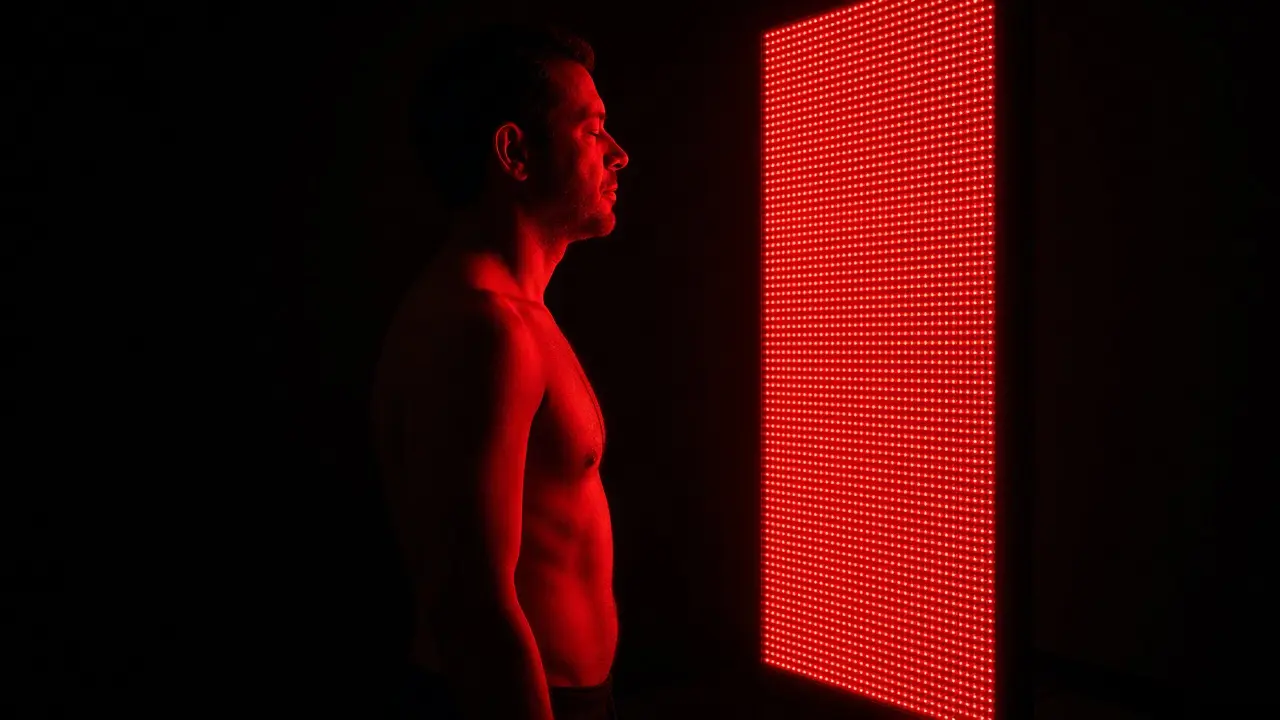
I went through meta-analyses and randomised trials on red and near-infrared light therapy. I have written down what is actually known, how much to use, and how to choose a panel. I am not recommending any specific product.
What photobiomodulation is
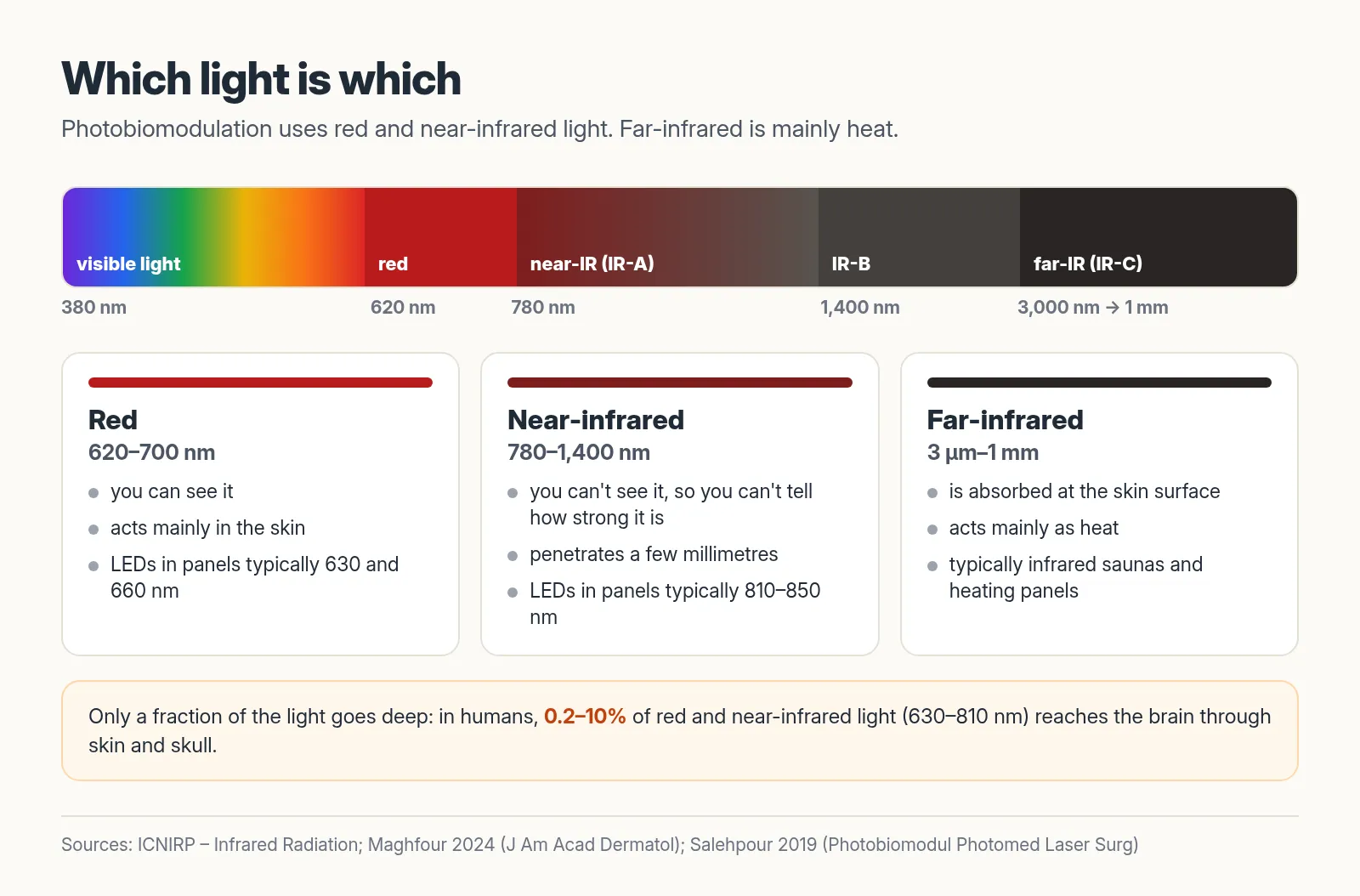
Photobiomodulation (PBM) is irradiation with red and near-infrared light at doses that do not heat the tissue. The light is absorbed by the enzyme cytochrome c oxidase in the mitochondria and changes the production of ATP, the cell’s energy (Maghfour 2024). Don’t link it to Niels Finsen’s 1903 Nobel Prize: he treated people with ultraviolet light (NobelPrize.org).
| Band | Wavelength | What it does |
|---|---|---|
| Red | 620–700 nm | You can see it; it acts mainly in the skin. |
| Near-infrared (NIR, IR-A) | 780–1,400 nm | You can’t see it; it penetrates a few millimetres. |
| Far-infrared (FIR, IR-C) | 3 µm–1 mm | It is absorbed at the skin surface and mainly heats. Typical of infrared saunas. |
Ranges according to ICNIRP. Little light reaches any depth: in humans, 0.2–10% of the light passes through skin and skull to the brain (Salehpour 2019).
Three units and one rule
- nm (nanometre) is the wavelength, the “colour” of the light. Panels typically have LEDs around 630–660 nm and 810–850 nm.
- Irradiance in mW/cm² tells you how much power falls on a square centimetre of skin. It drops quickly with distance.
- Dose in J/cm² is intensity × time. At 30 mW/cm² for 300 seconds you get 0.030 × 300 = 9 J/cm².
More is not better. Photobiomodulation has a biphasic dose response (the Arndt–Schulz curve): a small dose does nothing, a moderate dose works, and too high a dose reduces the effect again (Huang 2009).
What the science really knows (and what it doesn’t)
Studies differ a great deal in their parameters, and 73% of them did not even report how the light was measured (Hadis 2016). You therefore cannot transfer the results to a home panel one-for-one.
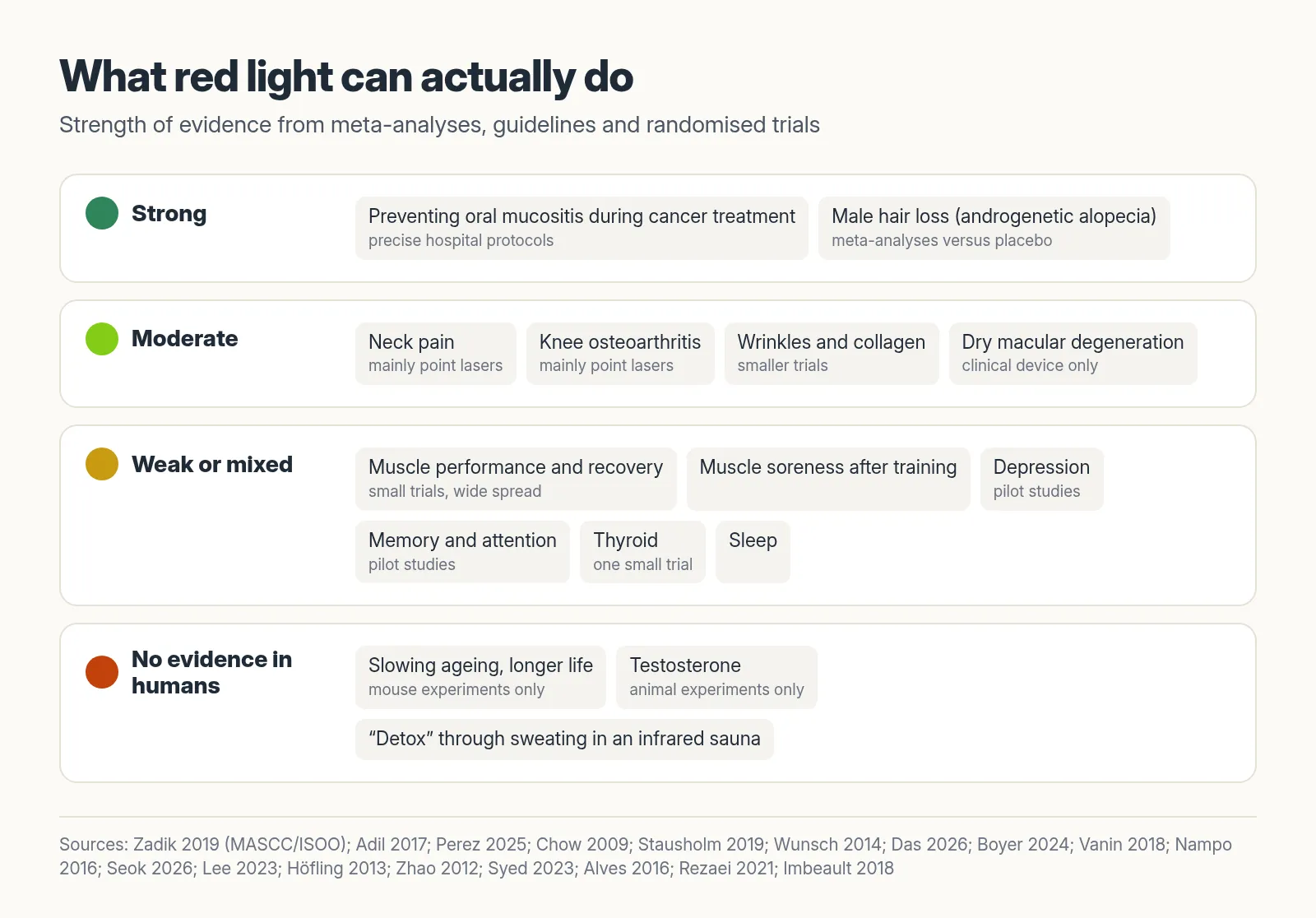
| Benefit | Strength of evidence | Note |
|---|---|---|
| Preventing oral mucositis during cancer treatment | strong | Only precise hospital protocols (Zadik 2019). |
| Male hair loss (androgenetic alopecia) | strong | Meta-analyses versus placebo, but the results vary widely (Adil 2017, Perez 2025). |
| Neck pain | moderate | 16 trials, mainly point lasers (Chow 2009). |
| Knee osteoarthritis | moderate | 22 trials, mainly point lasers (Stausholm 2019). |
| Wrinkles and collagen | moderate | Smaller trials, various protocols (Wunsch 2014, Das 2026). |
| Dry age-related macular degeneration | moderate | A clinical device only (Boyer 2024). |
| Muscle performance and recovery | weak to moderate | Small trials, wide spread (Vanin 2018). |
| Muscle soreness after training | weak | No substantial effect was shown (Nampo 2016). |
| Depression | weak to moderate | Blinded trials with a weak dose to the head did not work (Seok 2026, Iosifescu 2022). |
| Memory and attention | weak | Half of the studies were not randomised (Lee 2023). |
| Thyroid | weak | One trial with 43 patients, a laser applied directly to the neck (Höfling 2013). |
| Sleep | weak | One small unblinded trial (Zhao 2012). |
| Slowing ageing, longer life | none in humans | Animal experiments only (Syed 2023). |
| Testosterone | none in humans | Animal experiments only. |
- Skin. In a trial with 136 people, participants received about 9 J/cm² of red light twice a week, 30 sessions in total. Skin roughness and collagen density improved. A broad spectrum was no better than red light alone (Wunsch 2014).
- Pain. Neck pain fell by an average of 20 points on a 100-point scale (Chow 2009), knee pain by 14–16 (Stausholm 2019). But these were mostly lasers applied to points, not a panel used at a distance.
- Testosterone. I found no study in humans, only experiments on rams and on mice with damaged testes (Alves 2016, Rezaei 2021).
Longevity: mitochondria and ageing
Mitochondria produce less energy with age, and light helps them: it sounds great, but there is very little data in humans. The closest thing is small studies on the eyes: in people over 40, 670 nm light into the eye improved colour vision; in younger people it did not (Shinhmar 2020). In a study of 20 people, 3 minutes in the morning (8–9 a.m.) was enough; in six people treated at midday, nothing changed (Shinhmar 2021). This was a special, weak source, not a panel, which you must not look into.
A longer life has only been shown in a study of mice with faster-ageing hearts, in groups of eight animals (Syed 2023). That a panel will slow human ageing cannot be demonstrated today.
The brain and mood
Light to the head (transcranial PBM) is still at the stage of pilot studies. A meta-analysis of 18 depression trials found a moderate effect, but a larger one when the whole body was irradiated than when only the head was (Seok 2026). Two blinded trials with a weaker dose to the head did not differ from placebo (Iosifescu 2022, Guu 2025). For memory and attention, 29 of 35 studies report an improvement, but only half of the clinical trials were randomised (Lee 2023). Treat depression with a doctor; light will not replace that.
Sport: before or after training?
Before training comes out better. In a randomised trial, 48 men did strength training for 12 weeks. Those who used the light only before training gained the most strength; combining before and after was no better (Vanin 2016). A meta-analysis also found the most consistent results when the light was applied before exercise (Leal-Junior 2015). But the studies mostly used probes placed directly on the muscle, not a panel.
How much light to use
| Purpose | Wavelengths in the studies | Dose in the studies | How often | Source |
|---|---|---|---|---|
| Skin | 611–650 nm | about 9 J/cm² | twice a week, 30 sessions | Wunsch 2014 |
| Muscles before exercise | 655–950 nm | 20–60 J for a small muscle group, 60–300 J for a large one (total, not per cm²) | before exercise | Vanin 2018 |
| Knee osteoarthritis | 785–860 nm | 4–8 J per point | as the therapist decides | Stausholm 2019 |
| Hair | red | according to the approved device’s instructions | results after 4–26 weeks | Perez 2025 |
Session length: time in seconds = dose (J/cm²) ÷ intensity (W/cm²). For 9 J/cm² at 30 mW/cm² that is 9 ÷ 0.030 = 300 s, or 5 minutes.
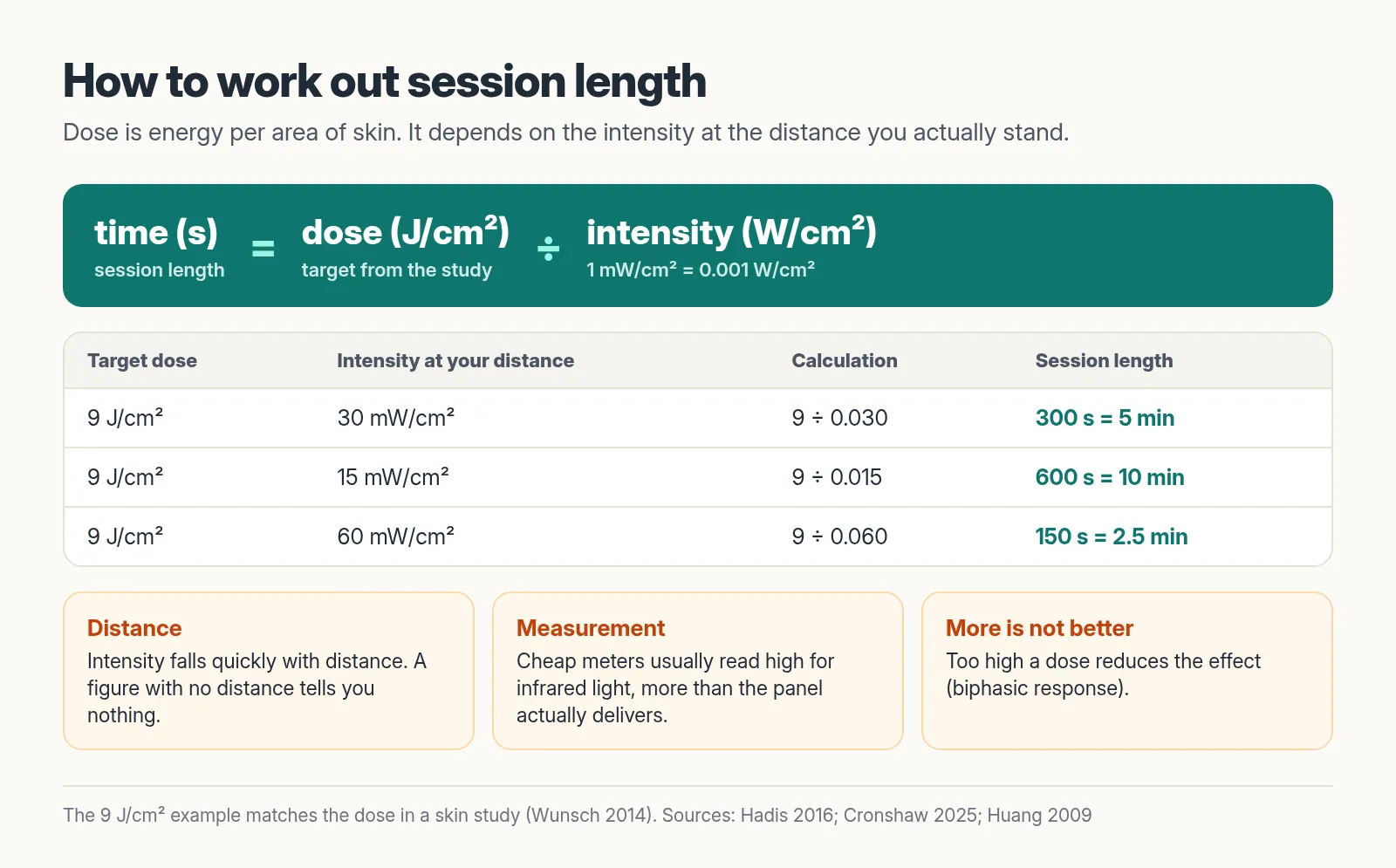
The calculation is only as good as the intensity figure. That depends on distance and the LED beam angle, and ordinary meters overstate infrared light (Hadis 2016). For five home LED devices, the manufacturers’ instructions did not lead to an accurate dose (Cronshaw 2025).
A start for beginners: a model example
Take a typical mid-size home panel. The manufacturer quotes around 100 mW/cm² at 15 cm; the real figure is often lower, because ordinary meters overstate infrared light (Hadis 2016). At 30 cm, therefore, count on about 30 mW/cm². The numbers are illustrative, not a measurement of a particular device.
| Model example | |
|---|---|
| Distance | 30 cm (you cover a larger area and the dose is easier to keep in check) |
| Intensity at 30 cm | about 30 mW/cm² |
| Target dose | 9 J/cm², as in the skin study (Wunsch 2014) |
| Duration | 9 ÷ 0.030 = 300 s, so 5 minutes per area |
| Frequency | 3 times a week (every other day); twice a week is enough for skin |
| How long to try | 8–12 weeks; take a photo of the starting state |
A stronger panel at 60 mW/cm² at 30 cm delivers the same dose in 2.5 minutes, a weaker one at 15 mW/cm² in 10 minutes. Longer sessions are not better; see the biphasic response.
How to do it at home
- Twice a week is enough for skin, that is how often it was used in the study (Wunsch 2014). For hair, follow the device’s instructions. Every day does not mean better; see the biphasic response.
- On bare skin. Clothing blocks the light. Studies did not measure the effect of creams and sunscreens, so shine the light on clean skin and put cream on afterwards.
- Keep the distance the manufacturer specifies and recalculate the session length for it. A different distance means a different dose.
- Protect your eyes: don’t look into the LEDs, and wear protective goggles. With a mask, follow the eye-protection instructions, and if you have a retinal disease or take medicines that increase sensitivity to light, speak to a doctor first.
- For sport, use the light before training. In the strength-training study the light was applied 5–10 minutes before exercise, with a probe directly on the muscle: 30 J per point, 180 J in total on the thigh (Vanin 2016). A meta-analysis found the most consistent results at 5–6 J per point (Leal-Junior 2015). A panel at 30 cm will not reproduce that exactly, but a short session immediately before training is enough.
- Be patient. For skin it was 30 sessions, so about four months; for hair, 4–26 weeks. Photograph the starting state so you can compare.
There is little data on evening use for sleep (Zhao 2012). Very intense red light can lower melatonin slightly, though much less than blue light (Hanifin 2006).
How I do it
I have a large panel with 660 nm red light and 850 nm infrared that covers half my body at once. I have not measured the intensity. From the manufacturer’s figures I estimate it delivers around 60 mW/cm² at 30 cm, which works out at about 3 minutes per position.
| Day | Training | What I light |
|---|---|---|
| Mon, Wed, Fri | strength training | upper body, front and back, 3 + 3 min |
| Tue, Thu, Sat | running (no training on Sat) | lower body, front and back, 3 + 3 min |
| Sun | – | a break |
- When: in the morning, 5–10 minutes before training.
- How: 30 cm from the panel, on bare skin. Each area thus gets the light every other day.
- A sore spot: I move it in to 20 cm and add 1–2 minutes, only on the days I already light that area.
- Eyes: when I light the upper body from the front I don’t wear goggles, I just close my eyes. I only do this for 3 minutes, and in series (4 weeks every other day, then a month with goggles). That’s my choice and a compromise with no verified data. Nobody has measured how much infrared light passes through the eyelids. For you, I recommend goggles.
Morning sunlight, for free
Infrared light makes up roughly 40% of sunlight at the Earth’s surface, and about 30–35 mW/cm² of near-infrared arrives. According to the author of a review, that is an intensity that benefits the skin, and morning infrared light supposedly prepares it for midday UV (Barolet 2021). But this is a hypothesis; no study has tested sunlight as photobiomodulation. And at midday, remember the UV.
Safety
- Skin. It is generally well tolerated; the most common effect is temporary redness (Maghfour 2024).
- Eyes. They are sensitive to thermal damage from infrared radiation, which you also cannot see (ICNIRP). Laser treatment into the eye for short-sightedness in children works in randomised trials (Jiang 2022), but a case of retinal damage has been described (Liu 2023). Two of four devices reached the safety limit in less than 3 seconds, while a session lasts 3 minutes (Ostrin 2026). Only under an eye doctor’s supervision.
- Cancer. A review found no evidence that photobiomodulation of the skin increases tumour risk (Glass 2023).
- See a doctor first if you have a cancer diagnosis, take medicines that increase sensitivity to light, are pregnant, or have epilepsy or an eye disease.
An infrared sauna is not red light
An infrared sauna mainly heats, and for lower blood pressure and better heart function in heart failure the evidence is limited (Beever 2009). The numbers do not support a “detox” through sweat: even with an extra litre of sweat a day you excrete less than 0.024% of the PCBs you eat daily in food (Imbeault 2018).
A cap, a mask, or a panel?
In the studies, light for hair is applied directly to the scalp, with a comb or a helmet (Adil 2017). In a randomised trial of 44 men, a 655 nm helmet was used at home every other day for 25 minutes over 16 weeks. Hair count rose 39% more than with a sham device (Lanzafame 2013). The same helmet came out similarly in 47 women (Lanzafame 2014). For the face, a review of 8 trials of home LED devices found improvements in wrinkles and skin elasticity (Das 2026).
With a mask, the eyes matter most. In 2019 a red-and-blue LED acne mask was recalled because of them. In people with some inherited retinal diseases, or who take medicines that increase sensitivity to light, there was a risk of retinal damage. Eye pain, blurred vision and changes in colour vision were also reported (TGA 2019).
| Cap / helmet | Mask | Panel | |
|---|---|---|---|
| For what | hair | facial skin | large areas, joints, sport |
| Area irradiated | the scalp | the face | depends on size and distance |
| How checkable the dose is | poor: the LEDs sit tight against the head and you can’t measure it at home | poor, same as with a cap | best: you can measure intensity at a given distance (Hadis 2016) |
| Eyes | shines away from the eyes | shines right by the eyes; a published safety assessment decides it | goggles required |
A simple rule: hair → a cap, face → a mask or a small panel, large areas and sport → a panel.
How to choose a panel: a checklist
- Shape and size for the purpose: a cap for hair, a mask or a small panel for the face, a large panel for the back or thighs.
- Intensity in mW/cm² with the distance and the meter, ideally measured with a spectroradiometer by an independent lab. A figure with no distance cannot be checked.
- Work out the session length. If it comes out at a few seconds, or half an hour, something doesn’t add up.
- Wavelengths and a measured spectrum: around 630–660 nm and 810–850 nm. More wavelengths are not automatically an advantage (Wunsch 2014).
- Flicker and electromagnetic fields: if the manufacturer promises “flicker-free” or “low EMF”, ask for the numbers.
- Certification. In the EU, CE marking; for therapeutic claims, registration as a medical device. “FDA registered” does not mean clearance (FDA).
- Protective goggles, the total price including a stand, the LED warranty and returns.
Prompt for choosing a panel
Show AI prompt
Copy the text below into your AI assistant with internet access (ChatGPT, Gemini, Perplexity, Grok…). It will ask you itself for what it needs to know.
Help me find a panel for red and near-infrared light therapy (red light therapy, photobiomodulation). This is not a heating infrared panel. Before you start searching, ask me about:
- the country I am buying in,
- my budget,
- what I want to use it for (e.g. skin, muscle recovery, joints and tendons, sleep, hair, general energy),
- which part of the body I want to irradiate (face, one area, half the body, the whole body) and how much space I have at home,
- how much time a day I want to spend on the therapy,
- whether I care about a pulsed mode, an app or intensity control,
- whether I take medicines or have a condition that increases sensitivity to light (e.g. photosensitising medicines, epilepsy, eye diseases, pregnancy, a cancer diagnosis).
Then suggest a suitable panel size and a target dose in J/cm² for my purpose according to published studies, and explain why, with links. Search only for products available in my country.

Select EXCLUSIVELY according to these criteria, not according to advertising claims, shop reviews or brand popularity:

1. Irradiance in mW/cm², always with the stated distance and type of meter. A spectroradiometer is more accurate; ordinary photodiode meters (e.g. solar meters) usually read high for infrared light. Mark a figure with no distance or no meter as unverifiable. State whether the manufacturer or an independent party did the measurement.
2. Session length for my target dose = dose (J/cm²) ÷ intensity (W/cm²) in seconds, for the distance the manufacturer recommends. Show the calculation.
3. Wavelengths: red (e.g. 630, 660 nm) and near-infrared (e.g. 810, 830, 850 nm). State whether the manufacturer publishes a measured spectrum, or only a list of wavelengths on the LEDs. List any other wavelengths (blue, green, 1060 nm and above) separately and do not treat them automatically as an advantage.
4. Irradiated area and panel dimensions, number of LEDs and beam angle, in relation to the body area I want to irradiate.
5. Flicker: a published flicker index or percent flicker, and what it was measured with, including at reduced intensity. "Flicker-free" alone, with no measurement, is not enough.
6. Electromagnetic field: magnetic (µT) and electric (V/m) at the use distance, and what it was measured with. "Low EMF" alone, with no numbers, is not enough.
7. Certification and regulation: CE and RoHS. State whether the product is registered as a medical device (in the EU under the MDR, in the US FDA 510(k) clearance). Note: "FDA registered" does not mean clearance.
8. Total price including a stand or mount and shipping, warranty (separately for the device and for the LEDs), return period, service in my country, and country of manufacture.

Rules:
- For every product, give a link to the source of every figure (manufacturer's page, manual, measurement report, certificate, medical-device register).
- If you cannot find a figure, write explicitly "not found". Do not guess or calculate anything without data.
- Do not take marketing claims ("most powerful", "clinically proven", "medical grade", "zero EMF") as facts.
- Put the result in a table: product | total price | dimensions and irradiated area | intensity (distance, meter, who measured) | session length for my dose | wavelengths (spectrum published yes/no) | flicker | EMF | certification / medical device | warranty and returns | missing data.
- First drop panels whose size does not match my purpose. Rank the rest by price only among those that have a published intensity with distance and meter and also flicker and EMF measurements. List the others separately, with a note on what is missing.
- At the end, remind me: protect the eyes (do not look directly into the LEDs; with near-infrared light use goggles), more light does not mean a better result because too high a dose reduces the effect, and if I take medicines that increase sensitivity to light, or I am pregnant, or I have an eye disease, epilepsy or a cancer diagnosis, I should speak to a doctor first.
Prompt for choosing a face mask
Show AI prompt
Help me find an LED face mask with red and near-infrared light (photobiomodulation). Before you start searching, ask me about:
- the country I am buying in, and my budget,
- what I want to use it for (e.g. wrinkles, skin elasticity, acne),
- whether I have an eye or retinal disease, take medicines that increase sensitivity to light, have epilepsy, or am pregnant,
- how much time a day I want to spend on the therapy.
Then suggest a target dose in J/cm² and a frequency for my purpose according to published studies, with links. Search only for products available in my country.

Select EXCLUSIVELY according to these criteria, not according to advertising claims, shop reviews or brand popularity:

1. Eye safety: a published photobiological safety assessment (e.g. according to IEC 62471) with the result for the eyes, eye protection (opaque covers, goggles) and the manufacturer's instructions. State whether the mask uses blue light, and flag that separately.
2. Irradiance in mW/cm² at the skin, what it was measured with and who measured it. Mark a figure with no measurement as unverifiable.
3. Dose per session = intensity (W/cm²) × time (s). Show the calculation and compare it with the dose from the studies.
4. Wavelengths (e.g. 630, 660, 830 nm) and whether a measured spectrum is published.
5. Number of LEDs and coverage of the face (forehead, area around the eyes, cheeks, neck).
6. Certification: CE, and whether the mask is registered as a medical device (in the EU under the MDR, in the US FDA 510(k) clearance). "FDA registered" does not mean clearance.
7. Total price, warranty, return period and service in my country.

Rules:
- For every figure, give a link to the source (manufacturer's page, manual, measurement report, certificate, register).
- If you cannot find a figure, write "not found". Do not guess.
- Do not take marketing claims ("clinically proven", "medical grade", "safe for the eyes" with no measurement) as facts.
- Put the result in a table: product | price | eye safety (assessment, protection) | blue light yes/no | intensity (meter, who measured) | dose per session | wavelengths | coverage | certification | missing data.
- List masks with no published eye-safety assessment separately at the end.
- At the end, remind me: if I have an eye disease or take medicines that increase sensitivity to light, I should speak to a doctor first, and if I get eye pain or changes in vision I should stop using the mask at once.
Prompt for choosing a cap or helmet for hair
Show AI prompt
Help me find a cap or helmet with red light for thinning hair (laser or LED, photobiomodulation). Before you start searching, ask me about:
- the country I am buying in, and my budget,
- whether I am a man or a woman, and what type of thinning I have (and whether a doctor has determined it),
- which part of the head I want to irradiate (crown, temples, the whole head),
- how much time a week I want to spend on the therapy,
- whether I take medicines that increase sensitivity to light or have a skin condition of the scalp.
Then summarise the protocols from published randomised trials (wavelength, session length, frequency, duration of treatment) with links. Search only for products available in my country.

Select EXCLUSIVELY according to these criteria, not according to advertising claims, shop reviews or brand popularity:

1. Wavelength: the studies usually used red light around 650–680 nm. State the wavelength and whether a measured spectrum is published.
2. Number of diodes, the ratio of lasers to LEDs, power per diode (mW) and coverage of the scalp (which areas the cap irradiates).
3. Session length and frequency according to the manufacturer, and a comparison with the protocols from the studies.
4. Medical-device status: in the EU under the MDR, in the US FDA 510(k) clearance with the decision number and the indication. "FDA registered" does not mean clearance.
5. A clinical trial of this specific device (randomised, with a blinded control), with a link.
6. Total price, warranty, return period (treatment takes months) and service in my country.

Rules:
- For every figure, give a link to the source (manufacturer's page, manual, FDA or EU register, study).
- If you cannot find a figure, write "not found". Do not guess.
- Do not take marketing claims ("clinically proven", "medical grade", "most diodes") as facts.
- Put the result in a table: product | price | wavelength | number and type of diodes | coverage | session length and frequency | medical-device status | a clinical trial of its own | warranty and returns | missing data.
- Rank by price only devices with verified medical-device status or a clinical trial of their own. List the others separately.
- At the end, remind me that results in the studies were assessed after months of regular use, and that a doctor should first determine the cause of the hair thinning.
Is it worth it?
The light makes sense if you are dealing with thinning hair (a cap rather than a panel), ageing skin, or long-term pain in a specific place, such as a knee. That is where the studies are strongest. But count on months of regular use, and on a fairly modest effect.
A wasted purchase is a panel for testosterone, detox or weight loss. There is no study in humans on testosterone, the numbers do not support a detox through sweat, and I found no good evidence that a home panel helps with weight loss. The same goes for slowing ageing. For sport and recovery it is a bet: a small effect is possible, there is no certainty.
Sources
- Maghfour J et al. (2024): Photobiomodulation CME part I: Overview and mechanism of action. J Am Acad Dermatol.
- NobelPrize.org: Niels Ryberg Finsen – Facts
- ICNIRP: Infrared Radiation
- Salehpour F et al. (2019): Penetration profiles of visible and near-infrared lasers and LED light through the head tissues. Photobiomodul Photomed Laser Surg.
- Huang YY et al. (2009): Biphasic dose response in low level light therapy. Dose Response.
- Hadis MA et al. (2016): The dark art of light measurement: accurate radiometry for low-level light therapy. Lasers Med Sci.
- Zadik Y et al. (2019): Systematic review of photobiomodulation for the management of oral mucositis…. Support Care Cancer.
- Adil A, Godwin M (2017): The effectiveness of treatments for androgenetic alopecia: a systematic review and meta-analysis. J Am Acad Dermatol.
- Perez SM et al. (2025): Low-level laser and LED therapy in alopecia: a systematic review and meta-analysis. Dermatol Surg.
- Chow RT et al. (2009): Efficacy of low-level laser therapy in the management of neck pain. Lancet.
- Stausholm MB et al. (2019): Efficacy of low-level laser therapy on pain and disability in knee osteoarthritis. BMJ Open.
- Wunsch A, Matuschka K (2014): A controlled trial to determine the efficacy of red and near-infrared light treatment…. Photomed Laser Surg.
- Das RK et al. (2026): Efficacy and safety of at-home LED photobiomodulation for facial rejuvenation. Aesthetic Plast Surg.
- Boyer D et al. (2024): LIGHTSITE III: multiwavelength photobiomodulation in dry age-related macular degeneration. Retina.
- Vanin AA et al. (2018): Photobiomodulation therapy for the improvement of muscular performance…. Lasers Med Sci.
- Nampo FK et al. (2016): Effect of low-level phototherapy on delayed onset muscle soreness: a systematic review and meta-analysis. Lasers Med Sci.
- Seok JW et al. (2026): Effect of photobiomodulation intervention for depressive symptoms: a systematic review and meta-analysis. J Affect Disord.
- Iosifescu DV et al. (2022): Very low-level transcranial photobiomodulation for major depressive disorder: the ELATED-3 trial. J Clin Psychiatry.
- Lee TL et al. (2023): Can transcranial photobiomodulation improve cognitive function? A systematic review of human studies. Ageing Res Rev.
- Höfling DB et al. (2013): Low-level laser in the treatment of patients with hypothyroidism induced by chronic autoimmune thyroiditis. Lasers Med Sci.
- Zhao J et al. (2012): Red light and the sleep quality and endurance performance of Chinese female basketball players. J Athl Train.
- Syed SB et al. (2023): Photobiomodulation therapy mitigates cardiovascular aging and improves survival. Lasers Surg Med.
- Alves MB et al. (2016): Low-level laser therapy to recovery testicular degeneration in rams. Lasers Med Sci.
- Rezaei F et al. (2021): Photobiomodulation therapy improves spermatogenesis in busulfan-induced infertile mouse. Reprod Sci.
- Shinhmar H et al. (2020): Optically improved mitochondrial function redeems aged human visual decline. J Gerontol A Biol Sci Med Sci.
- Shinhmar H et al. (2021): Weeklong improved colour contrasts sensitivity after single 670 nm exposures…. Sci Rep.
- Guu TW et al. (2025): Wearable, self-administered transcranial photobiomodulation for major depressive disorder and sleep. J Affect Disord.
- Vanin AA et al. (2016): What is the best moment to apply phototherapy when associated to a strength training program?. Lasers Med Sci.
- Leal-Junior EC et al. (2015): Effect of phototherapy on exercise performance and markers of exercise recovery: a systematic review with meta-analysis. Lasers Med Sci.
- Cronshaw M et al. (2025): Photobiomodulation LED devices for home use: design, function and potential. Dent J (Basel).
- Hanifin JP et al. (2006): High-intensity red light suppresses melatonin. Chronobiol Int.
- Barolet D (2021): Near-infrared light and skin: why intensity matters. Curr Probl Dermatol.
- Jiang Y et al. (2022): Effect of repeated low-level red-light therapy for myopia control in children. Ophthalmology.
- Liu H et al. (2023): Retinal damage after repeated low-level red-light laser exposure. JAMA Ophthalmol.
- Ostrin LA et al. (2026): Safety evaluation of 4 red light therapy devices for myopia. JAMA Ophthalmol.
- Glass GE (2023): Photobiomodulation: a systematic review of the oncologic safety…. Aesthet Surg J.
- Beever R (2009): Far-infrared saunas for treatment of cardiovascular risk factors. Can Fam Physician.
- Imbeault P et al. (2018): Can POPs be substantially popped out through sweat?. Environ Int.
- Lanzafame RJ et al. (2013): The growth of human scalp hair mediated by visible red light laser and LED sources in males. Lasers Surg Med.
- Lanzafame RJ et al. (2014): The growth of human scalp hair in females using visible red light laser and LED sources. Lasers Surg Med.
- TGA (2019): Neutrogena Visibly Clear Light Therapy Acne Mask and Activator – recall
- FDA: Important Reminders about Registration and Listing